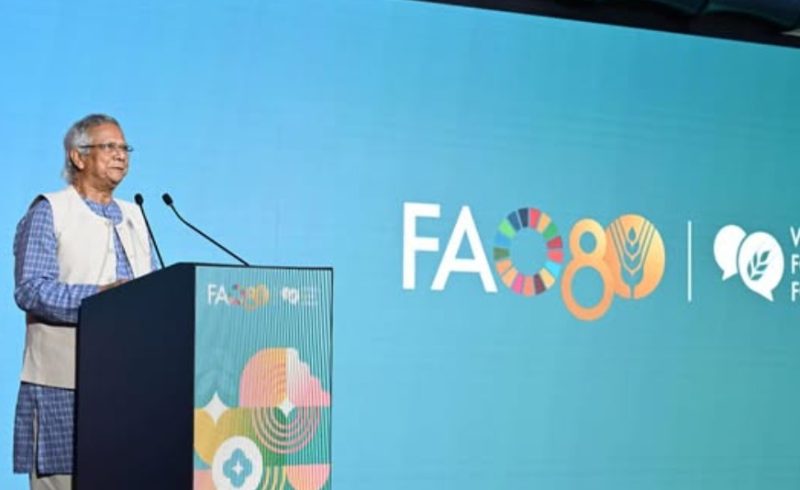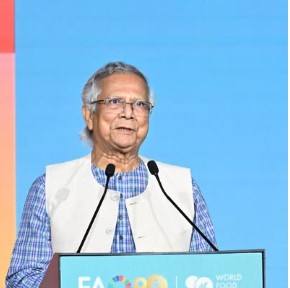
Chief Adviser Professor Muhammad Yunus delivered his remarks during the plenary session of the World Food Forum, held at the FAO Headquarters in Rome on Monday.
Full speech here:
Excellencies, Distinguished Delegates, Friends,
It is a deep honour for me to join you today at this important gathering of the World Food Forum. I thank Dr. QU Dongyu, Director-General of FAO, for this kind invitation — and for your bold vision in making this forum a platform for action, not just discussion.
Eighty years of FAO is not just a celebration. It is a call to prepare — for the future. This year’s theme, “Hand in Hand for Better Food and a Better Future”, reminds us: food is not just about calories. It’s about dignity. It’s about justice. It’s about the world we want to live in.
A people’s movement, led by youth
Last year, people of Bangladesh rose peacefully to reclaim their power to ensure democracy, peace, and human rights for all. It was our youth — young people full of courage and hope — who led that movement. Their demand was simple: to give power back to the people. To create a society based on fairness, inclusion, and trust.
Today, those young people are engaged in the rebuilding of our institutions. They are shaping a new Bangladesh — one that puts its people at the center of governance. In February, we will hold our national election — and with it, we institutionalize our commitment to justice and people’s power.
A country that feeds its people — and more
In Bangladesh, despite our small land area — half of Italy — we feed over 170 million people, and also support 1.3 million Rohingyas who fled under violence in Myanmar.
We have become self-sufficient in rice — our staple. We are among the world’s top producers of rice, vegetables, and freshwater fish. Our farmers have raised cropping intensity to 214%. We’ve released 133 climate-resilient rice varieties. We’ve mechanized farming, with subsidies of up to 70%. We’ve built a robust food distribution system. We are reducing stunting. We are diversifying diets. We are greening our agriculture — protecting soil, water, and biodiversity.
I am very happy that the Nobel Peace Laureates alliance for Food Security and Peace which was established by FAO in 2016 and of which, I am a member has been recognized as an FAO milestone. I hope it will continue to create more milestones.
But let us speak the truth clearly:
Hunger is not caused by scarcity. It is caused by the failure of the economic framework that we have designed.
In 2024, 673 million people went hungry. Yet we produce more than enough food. This is not a failure of production — it’s a failure of the economic system. It’s a moral failure.
While we couldn’t raise a few billion dollars to end hunger, the world spent 2.7 trillion dollars on weapons. Is this how we define progress?
We must change the system. Let me propose a few steps:
1. Break the hunger–conflict cycle — stop the wars, start the dialogue, ensure food access in conflict zones.
2. Keep the promises — fulfil the SDG finance commitments, take climate action seriously, and help the most vulnerable build resilience.
3. Create regional food banks — to manage shocks and stabilize supply chains.
4. Create and support local entrepreneurs, particularly youth entrepreneurs — with finance, infrastructure, and global partnerships.
5. End export bans — trade rules must support food security, not undermine it.
6. Ensure access to and development of technology and innovation — especially for the Global South, and to the rural youth, both boys and girls.
But we must go deeper. We must rethink the entire economic system.
The old way —which is based on profit-maximizing business, — has left billions behind. We need to add a new kind of business — social business, business without personal profit, — that solves problems, not creates them, by creating sustainable businesses. Many social businesses are growing around the world but without policy support and institutional recognition.
Ultimate objective is to create a “Three-Zero World”: A world with
• Zero Wealth Concentration to end Poverty
• Zero Unemployment, by replacing it with entrepreneurship for all
• Zero Net Carbon Emissions
This is not a dream. It is a necessity, the only way to save the world.
Social business is the way forward. We’ve seen its power in Bangladesh. Grameen Bank showed how poor women can be powerful entrepreneurs. Grameen Danone fights child malnutrition. And other social businesses created around the world have empowered people and communities. These are not theories — they are living examples.
We must create social business funds — to support young entrepreneurs, women, farmers, agri-business creators and technology developers. We must build legal and financial frameworks to support this kind of entrepreneurship — not stand in its way.
And this brings me to the most important part: our youth.
Today’s young people are not like before. They are connected. They are creative. They have technology in their hands that were unthinkable just 20 years ago.
Let’s not tell them to wait for jobs. Let’s empower them to create jobs. Let’s tell them: you are not job-seekers — you are job creators.
Let us give them access to capital — by creating investment funds and social business funds. Let us help create agri-innovation hubs. Let us support agri-tech, circular food systems, climate-smart enterprises — all can be led by the youth.
If we invest in youth, we will not only feed the world, we’ll change the world.
Bangladesh is proud to support global cooperation. We are a founding member of the Global Alliance Against Hunger and Poverty. Together with FAO and under the G20, we are committed to real, practical support — technical, financial, and moral.
Now, let us work together — to build a Three-Zero World.
The pillars of this forum — Youth, Science, Investment — are not slogans. They are the tools we need to transform our food systems and our societies.
Today’s world has resources. It has the technology. It will have more mind-boggling technology. But we need the creative ideas to use this technology with appropriate business format to create a new world.
If we can imagine it, we can create it.